Flower Moon
Along woodland edges and in gardens, spring flowers open across the northern United States. Leaves are unfolding, and planting is part of the season’s work. The May full moon carries a name drawn from this activity on the ground, not from a change in the Moon itself.
, 2027
· 10:59 UTC · Moon in Scorpio
Where the name comes from
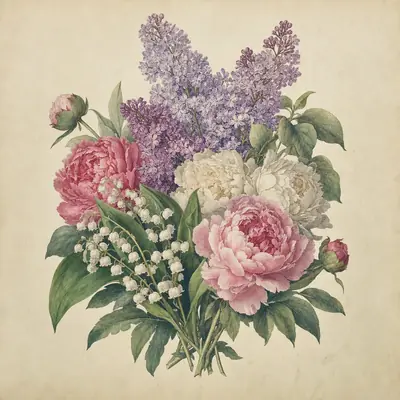
The name Flower Moon refers to the many flowers blooming during May in parts of North America. The Old Farmer’s Almanac lists it as a term used by Algonquin and Ojibwe peoples, while the Farmers’ Almanac includes it in its familiar sequence of seasonal full moon names. Royal Museums Greenwich also connects the name with spring flowering, without assigning it to a single people. These accounts agree on the seasonal reference, but they do not establish one inventor or a single naming tradition shared across the continent.
The modern lists bring together traditions rather than preserving one universal calendar. The Farmers’ Almanac describes its names as a mixture of Indigenous North American, colonial American, and European customs, with differences between nations, regions, and historical periods. Sources also differ in placement and attribution: timeanddate lists Flower Moon among English names for June, while Wikipedia records an older almanac list that attributed Flower Moon and other seasonal names to early English ancestors. The Old Farmer’s Almanac further explains that such names traditionally referred to the whole lunar month, not just the full moon. May’s familiar label is therefore best understood as an almanac convention rooted in seasonal observations, rather than an exclusive name with a settled origin.
Other names for the May full moon
- Budding Moon — Cree
- Leaf Budding Moon — Cree
- Egg Laying Moon — Cree
- Planting Moon — Dakota, Lakota
- Moon of the Shedding Ponies — Oglala
- Milk Moon — Anglo-Saxon
What the season is doing
In the northern United States, the name points toward spring flowering, unfolding leaves, and the work of starting crops. The Old Farmer’s Almanac lists Budding Moon, Leaf Budding Moon, and Egg Laying Moon as Cree terms, shifting attention from blossoms to other signs of the season. It lists Planting Moon as a Dakota and Lakota name associated with sowing seeds, and Moon of the Shedding Ponies as an Oglala term. These alternatives describe changes in plants, animals, and farm work rather than a single event happening everywhere at once. Their seasonal frame belongs to the Northern Hemisphere, not to a worldwide flowering season.
What the name does not mean
The word “Flower” does not describe a special color, shape, or size of the Moon. Royal Museums Greenwich and the Old Farmer’s Almanac explain the label through flowers blooming on Earth, not through a distinctive appearance in the sky. A seasonal name and a physical description are different things: this name alone gives no reason to expect a pink disk or an unusually large moon. Its usefulness is as a reminder of flowers opening below, rather than a promise of a different-looking object above.
Flower Moon dates, 2025 to 2030
Between 2025 and 2030 the Flower Moon falls as early as May 1 (2026) and as late as May 27 (2029), in Scorpio or Sagittarius: a full moon sits opposite the Sun, which at this time of year is in Taurus or Gemini.
When the name moves
May 2026 has two full moons: the Flower Moon on May 1 and a Blue Moon on May 31. The first keeps the month's name; the second is the Blue Moon.
The Flower Moon is the same disc for everyone. Which part of your own chart it falls across depends on your birth date, and that is what a personal reading looks at. See a reading built from your birth moon →
Affiliate link — we may earn a commission at no cost to you.Questions
When is the Flower Moon in 2027?
On Thursday, May 20, 2027, at 6:59 AM EDT (10:59 UTC), with the Moon in Scorpio. Central, Mountain and Pacific clocks read one, two and three hours earlier.
What are other names for the Flower Moon?
Milk Moon is one alternative that timeanddate identifies as Anglo-Saxon. Royal Museums Greenwich also lists hare moon and corn planting moon, alongside milk moon. These are alternatives found in published naming lists, not interchangeable translations of one original term. Their associations extend beyond flowers to animals and agricultural work.
Is the Flower Moon the same as the Pink Moon?
In the common almanac sequence, they label different months: Pink Moon belongs to April, and Flower Moon to May. The Farmers’ Almanac connects the former with creeping phlox, a spring wildflower, and the latter with more widespread flowering. Both names refer to plants rather than predicting the Moon’s color.
Does the Flower Moon name tell you when to plant?
It offers a seasonal association, not a precise planting instruction. The Old Farmer’s Almanac connects the alternative Planting Moon with starting seeds and crops, while the Farmers’ Almanac emphasizes regional variation in traditional names. Read the label as a record of seasonal work, not as evidence that full moonlight determines when crops should be planted.
The months either side
Sources for the name and its history: almanac.com · timeanddate.com · farmersalmanac.com · en.wikipedia.org · science.howstuffworks.com · sciencefocus.com · rmg.co.uk. Dates, times and signs: our own calculation, checked against the US Naval Observatory.