Hunter's Moon
Across harvested fields, there is less cover for wildlife, and the woods are losing their leaves. The name Hunter's Moon belongs to this seasonal shift: from bringing in crops to hunting and preserving meat for the colder months ahead.
, 2026
· 04:11 UTC · Moon in Taurus
Where the name comes from
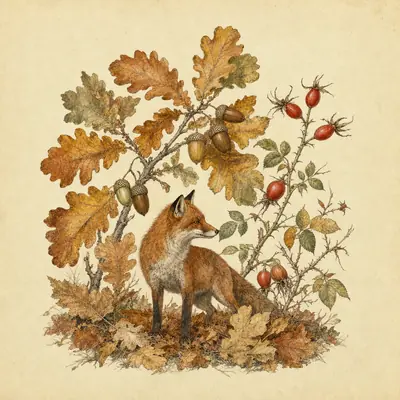
The familiar explanation connects the name with hunting after the crop harvest, when cleared fields made animals easier to see and game had fattened through summer and early fall. The Old Farmer's Almanac describes this as a time to prepare meat for winter, with moonlight extending the available evening light. Royal Museums Greenwich gives a similar account, mentioning deer and foxes in bare fields. The name reflects autumn in the Northern Hemisphere, rather than a change in the Moon itself. Wikipedia traces written evidence of the English expression to a reference to “country people,” which is narrower evidence than claims of a single Indigenous origin.
The Old Farmer's Almanac lists Drying Rice Moon as a Dakota name and Falling Leaves Moon as an Anishinaabe name; it also lists Freezing Moon as Ojibwe and Ice Moon as Haida. The Farmers' Almanac also uses Hunter's Moon and connects it with hunting and winter provisions. The publications differ over the label: the Old Farmer's Almanac calls October's full moon the Hunter's Moon unless October holds the Harvest Moon. timeanddate.com says the Hunter's Moon is always the full moon after the Harvest Moon, moving it to November when the Harvest Moon falls in October.
Other names for the October full moon
- Drying Rice Moon — Dakota
- Falling Leaves Moon — Anishinaabe
- Freezing Moon — Ojibwe
- Ice Moon — Haida
What the season is doing
In the northern United States, the seasonal picture behind the name includes harvested fields, thinning leaf cover, and preparations for winter. The Old Farmer's Almanac emphasizes game animals that have fattened through the warmer months and are easier to spot where crops have been cut. Its alternative names turn attention toward other parts of the season: drying rice, falling leaves, freezing conditions, and ice. These are different seasonal reference points, not a promise that leaves fall and ponds freeze everywhere at once. Read alongside one another, the names describe food gathering and the approach of cold from several perspectives.
What the name does not mean
An orange moon near the horizon is not a special feature of this name. As Wikipedia explains, its warm appearance comes from the atmosphere scattering light while the Moon is low in the sky, rather than from its being a harvest or hunting moon. The seasonal label does not change the Moon's color or size. A reddish Moon during a total lunar eclipse is a separate phenomenon, even though the term Blood Moon also appears among traditional alternatives for this seasonal full moon.
Hunter's Moon dates, 2025 to 2030
Between 2025 and 2030 the Hunter's Moon (counting the Old Farmer's Almanac dates) falls as early as October 11 (2030) and as late as October 26 (2026), in Aries or Taurus: a full moon sits opposite the Sun, which at this time of year is in Libra or Scorpio.
When the name moves
Almanacs disagree here. The Old Farmer's Almanac calls October's full moon the Hunter's Moon unless October holds the Harvest Moon, and in those years (2025 and 2028) it has no Hunter's Moon at all, keeping Beaver Moon for November. timeanddate.com defines the Hunter's Moon as the full moon after the Harvest Moon, which makes it November's in those years: November 5, 2025 and November 2, 2028.
The Hunter's Moon is the same disc for everyone. Which part of your own chart it falls across depends on your birth date, and that is what a personal reading looks at. See a reading built from your birth moon →
Affiliate link — we may earn a commission at no cost to you.Questions
When is the Hunter's Moon in 2026?
On Monday, October 26, 2026, at 12:11 AM EDT (04:11 UTC), with the Moon in Taurus. Central, Mountain and Pacific clocks read one, two and three hours earlier.
Why is it called the Hunter's Moon?
The name points to a shift in seasonal work, from gathering crops to securing meat for winter. In the explanation given by the Old Farmer's Almanac, open fields offered less hiding cover for wildlife. Moonlit evenings also gave hunters more light, linking the name to both the cleared fields and practical preparation.
Is the Hunter's Moon a Native American name?
It is too broad to present it as a name shared by all Native American peoples. Wikipedia discusses an English written record, while the Old Farmer's Almanac credits distinct seasonal alternatives to particular peoples. Those separate attributions are more useful than treating today's familiar monthly list as one universal tradition.
Why is the Hunter's Moon also called the Blood Moon?
timeanddate lists Blood Moon and Sanguine Moon as Pagan alternatives for this full moon. That is a naming tradition, not a prediction of what observers will see. The same publication distinguishes this usage from Blood Moon as a popular term for a total lunar eclipse, so the context matters.
The months either side
Sources for the name and its history: almanac.com · timeanddate.com · farmersalmanac.com · en.wikipedia.org · rmg.co.uk · abc7news.com · abc7ny.com · crystalvaults.com. Dates, times and signs: our own calculation, checked against the US Naval Observatory.