Wolf Moon
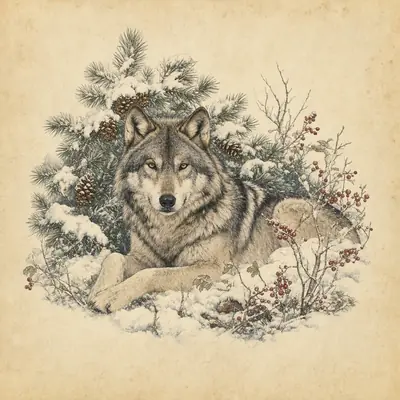
Snow covers the ground, and long nights settle over the northern United States. A wolf’s howl carries through the winter dark, though hunger is not its only explanation. The January full moon carries that sound in its familiar name, the Wolf Moon.
, 2027
· 12:17 UTC · Moon in Leo
Where the name comes from
English roots are the explanation favored by the Old Farmer’s Almanac, which describes Wolf Moon as a name thought to have reached North America with European settlers. Timeanddate suggests Celtic and Old English roots, while the Farmers’ Almanac lists it among the traditional names used today for January’s full moon. Accounts differ: some popular summaries connect it with both Native American and European traditions, so its origin should not be presented as universally agreed. The shared seasonal explanation is more consistent: the name evokes wolves heard howling during the long, cold nights of midwinter, rather than a distinctive feature of the moon itself.
Other names describe the same season through cold, snow, or its place in the winter calendar. The Old Farmer’s Almanac lists Center Moon as an Assiniboine name referring to the approximate middle of the cold season, and gives Severe Moon and Hard Moon as Dakota names. It explains Hard Moon through the crust that develops on fallen snow and also lists Cold Moon as a Cree name. Timeanddate gives the Anglo-Saxon name Moon After Yule and includes Quiet Moon among Celtic alternatives. These are names gathered from different traditions, not interchangeable entries in one universal calendar; the Old Farmer’s Almanac notes that many Indigenous moon names referred to an entire lunar month.
Other names for the January full moon
- Center Moon — Assiniboine people of the Northern Great Plains
- Severe Moon — Dakota
- Hard Moon — Dakota
- Cold Moon — Cree
- Moon After Yule — Anglo-Saxon
- Quiet Moon — Celtic
What the season is doing
Across the northern United States, the seasonal picture behind these names is one of cold, snow-covered ground, and long winter nights, though conditions vary by place. Fallen snow can develop a hard crust, the feature the Old Farmer’s Almanac associates with Hard Moon, while Center Moon places attention on the middle of the cold season. Where wolves live, their winter calls serve the practical work of finding pack members, maintaining bonds, and defending territory. Read together, the names draw attention to both the conditions underfoot and the animal life that continues through winter, rather than to any change in the moon.
What the name does not mean
The familiar story that wolves howl because they are hungry is too simple. Timeanddate repeats the hungry-wolf explanation, but the Old Farmer’s Almanac explicitly corrects it, describing howling as communication used to locate pack members, reinforce social bonds, define territory, and coordinate hunting. Those functions explain why a howl should not be treated as a direct measure of winter hunger. The name preserves an association between wolves and midwinter; it does not establish that the full moon causes wolves to howl or that their calls are directed at it.
Wolf Moon dates, 2025 to 2030
Between 2025 and 2030 the Wolf Moon falls as early as January 3 (2026) and as late as January 30 (2029), in Cancer or Leo: a full moon sits opposite the Sun, which at this time of year is in Capricorn or Aquarius.
The Wolf Moon is the same disc for everyone. Which part of your own chart it falls across depends on your birth date, and that is what a personal reading looks at. See a reading built from your birth moon →
Affiliate link — we may earn a commission at no cost to you.Questions
When is the Wolf Moon in 2027?
On Friday, January 22, 2027, at 7:17 AM EST (12:17 UTC), with the Moon in Leo. Central, Mountain and Pacific clocks read one, two and three hours earlier.
Does the Wolf Moon look different from other full moons?
Wolf Moon is a traditional seasonal label, not a description of a special color or size. The word “wolf” refers to the animal associated with winter howling in accounts of the name. It does not identify a separate kind of astronomical event or promise an unusual appearance.
Is the Wolf Moon name Native American?
It should not be labeled simply as a Native American name. The Old Farmer’s Almanac favors an English origin, while timeanddate points to Celtic and Old English roots. Indigenous alternatives have their own specific attributions, which are better preserved than grouped under a single origin story.
Why is the Wolf Moon a winter name if January is summer where I live?
The winter imagery belongs to the Northern Hemisphere seasonal setting of the name. Its use in January does not make cold weather or snow universal. Readers elsewhere can recognize it as an inherited calendar label without treating its snow and winter nights as a description of their own surroundings.
The months either side
Sources for the name and its history: almanac.com · timeanddate.com · farmersalmanac.com · en.wikipedia.org · nwtrek.org · vaonis.com · space.com · rmg.co.uk. Dates, times and signs: our own calculation, checked against the US Naval Observatory.