Worm Moon
Unlike April's flower-named moon, March's full moon takes its familiar name from life stirring around the thaw. The usual explanation points to earthworms in warming soil. Another account points to larvae emerging from tree bark and other winter shelters.
, 2027
· 10:43 UTC · Moon in Libra
Where the name comes from
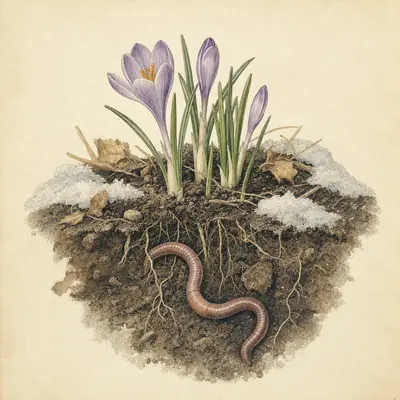
Earthworms in warming soil are the familiar explanation for the name Worm Moon, but the Old Farmer's Almanac also presents an account involving insect larvae. It connects that explanation to Jonathan Carver, whose travel account described these other “worms” emerging from tree bark and winter hiding places. Royal Museums Greenwich gives the earthworm explanation, describing trails in newly thawed ground, while timeanddate also points to earthworms returning with warmer soil. The publications differ on whether to include the larvae account, so the familiar earthworm story is best presented alongside it rather than as an uncontested origin.
The Farmers' Almanac also lists Worm Moon for March, linking it to softening ground and the approach of spring. The Old Farmer's Almanac describes its full moon names as a mixture of Native American, Colonial American, and European sources, and notes that such names traditionally referred to a whole lunar month rather than only the full moon night. It also supplies the cultural attributions for the alternative names listed here. Read together, these labels describe several features of the season, from returning birds and running maple sap to bright snow and dwindling food supplies.
Other names for the March full moon
- Crow Comes Back Moon — Northern Ojibwe
- Snow Crust Moon — Anishinaabe
- Sore Eyes Moon — Dakota, Lakota, and Assiniboine
- Sugar Moon — Ojibwe
- Wind Strong Moon — Pueblo
- Goose Moon — Haida
What the season is doing
Across the northern United States, the seasonal picture behind these names includes both thawing ground and lingering snow. Warming soil and activity around tree bark do not necessarily mean that fields and woods are already green. The Old Farmer's Almanac connects Sugar Moon with running maple sap, Snow Crust Moon with the snow surface, and Sore Eyes Moon with sunlight glaring off snow. Its returning-bird names add crows and geese to that picture, while the Cherokee names “Month of the Bony Moon” and “Hungry Moon” recall a less comfortable part of the season: food could still be difficult to find.
What the name does not mean
A common mistake is to treat Worm Moon as one universal Indigenous name, shared across North America in a fixed monthly calendar. The Old Farmer's Almanac instead lists different names with specific cultural attributions, while Wikipedia summarizes historical accounts that disagree about how consistently lunar months were named. That evidence supports a varied naming tradition, not a single continent-wide vocabulary. Worm Moon is now a familiar almanac label, but its widespread use does not make it the original or preferred name for every community.
Worm Moon dates, 2025 to 2030
Between 2025 and 2030 the Worm Moon falls as early as March 3 (2026) and as late as March 29 (2029), in Virgo or Libra: a full moon sits opposite the Sun, which at this time of year is in Pisces or Aries.
The Worm Moon is the same disc for everyone. Which part of your own chart it falls across depends on your birth date, and that is what a personal reading looks at. See a reading built from your birth moon →
Affiliate link — we may earn a commission at no cost to you.Questions
When is the Worm Moon in 2027?
On Monday, March 22, 2027, at 6:43 AM EDT (10:43 UTC), with the Moon in Libra. Central, Mountain and Pacific clocks read one, two and three hours earlier.
Is the Worm Moon the same as the Lenten Moon?
Both names appear in modern lists for March's full moon. timeanddate gives Lenten Moon as an Anglo-Saxon name and connects it with the Germanic word Lenten, meaning spring; the Farmers' Almanac also lists it as an alternative. They offer different seasonal descriptions of the same monthly full moon, rather than two separate kinds of moon.
Do worms come out because of the Worm Moon?
The Old Farmer's Almanac and timeanddate explain the appearance of earthworms through warming soil, not through a special influence of this full moon. The name associates a lunar month with a seasonal observation. It is not a promise that worms will appear on the night the moon is full, especially where the ground remains frozen.
Does the Worm Moon look different from other full moons?
The word “worm” describes life on or near the ground, not a visible feature of the moon. It does not designate a special color, shape, or size. The Old Farmer's Almanac discusses changes in appearance caused by an eclipse or the moon illusion separately from the seasonal explanation for the name.
The months either side
Sources for the name and its history: almanac.com · timeanddate.com · farmersalmanac.com · en.wikipedia.org · rmg.co.uk · nativepartnership.org · medium.com · novalore.co.uk. Dates, times and signs: our own calculation, checked against the US Naval Observatory.