Full Moon Ritual
Full moon practice across unrelated cultures shares one move: something is released rather than started.
Next full moon: Monday, October 26, 2026, 04:11 UTC
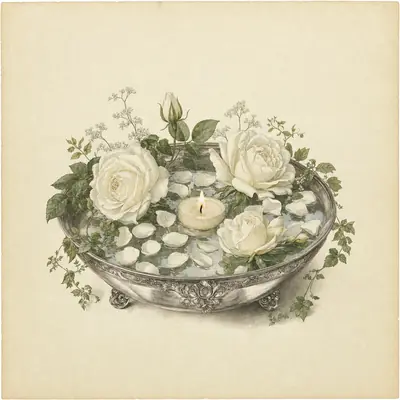
The steps
- Name what is finished — a project, a grudge, a version of yourself that the last two weeks disproved.
- Do something physical with it: burn the paper safely, delete the folder, return the borrowed thing.
- Write down what actually came of the intention set at the new moon. Honestly, including nothing.
The honest part
The moon is bright enough to work by. If you can do this outside, do — the point of a ritual is that it is not the same as thinking about it indoors.
What the practice is for
A full moon is the part of the lunar cycle when the Moon is opposite the Sun in our sky and the near side is fully lit. The exact instant is an astronomical event, listed by moon calendars in UTC, but the bright round Moon is usually noticeable for a night or two on either side. A practice held then borrows from that visibility: it asks you to look plainly at what has ripened, ended, or become too obvious to ignore.
Across unrelated cultures, full moon practice shares one common move: something is released rather than started. That does not mean the Moon removes a problem for you. In traditional and modern ritual language, the phase is read as a time for completion, reckoning, and letting a form change because it has reached its limit.
Where the custom comes from
There is no single original full moon rite behind today’s notebooks, candles, bowls of water, and outdoor circles. People have watched the Moon for practical reasons for a very long time: night travel, tides, planting calendars, hunting, festival timing, and religious observance. Those uses are not the same as contemporary personal ritual, but they explain why the full moon became an obvious marker in human timekeeping.
Many traditions give full moons public or devotional roles: Buddhist observance days, Hindu festivals, agricultural calendars, and seasonal folk customs, among others. Modern moon rituals often combine older timing habits with journaling, household ceremony, and self-reflection. It is better to name that mixture than pretend it descends unchanged from one ancient source.
A sequence that keeps the point
The useful structure is simple: name what has reached its limit, make a concrete gesture, then record what actually happened. The full moon is bright enough to work by. If you can do this outside, do; the point of a ritual is that it is not the same as thinking about it indoors.
- Name what is finished: a project, a grudge, an argument you keep rehearsing, or a version of yourself the last two weeks disproved.
- Do something physical with it: burn the paper safely, delete the folder, return the borrowed thing, wash the cup, clear the shelf, or send the email you have already decided on.
- Write down what came of the intention set at the new moon. Include the unflattering answer if nothing came of it, because that is information too.
This is not a performance test. A small action is often cleaner than an elaborate scene that distracts from the decision. If fire, darkness, weather, or privacy makes the ritual unsafe, choose a different physical mark of completion, such as tearing paper, crossing out a line, or putting an object back where it belongs.
Common variations people actually use
Most variations change the sensory frame rather than the central act. People add sound, water, movement, prayer, silence, cards, or a shared meal because these make the moment distinct from ordinary planning. In traditional practice, that distinction matters: the gesture tells the body and the household that this is not another loose thought.
- Journaling: reviewing the past two weeks or the whole lunar month, then choosing one sentence to release.
- Candle practice: lighting one candle for attention, not because the flame guarantees an outcome.
- Water on a windowsill: used by some as a symbolic object for reflection; treat it as symbolic unless you have a safe reason to drink or use it.
- Bathing or washing hands: a bodily way to mark closure, especially when the matter is emotional rather than logistical.
- Walking outside: letting the bright night change the setting before writing or speaking the release.
- Group circles: useful when witnesses help people be specific, less useful when everyone copies the same script.
The variation is secondary to the verb. Release, return, finish, admit, clear, archive, forgive, or stop are different actions. If the ritual never reaches a verb, it may feel atmospheric but remain vague.
What to skip, and why
Skip anything that turns the Moon into a vending machine. Claims that a full moon will attract abundance, force another person to change, or cleanse your life for you move away from both astronomy and sober tradition. The Moon is not making a contract; you are choosing a marked time to examine and close something.
- Do not burn paper indoors, near dry grass, or in wind. A ritual that creates danger has lost the plot.
- Do not use practices from living cultures as costume. If a custom is not yours and you have not been taught it, choose a plain gesture instead.
- Do not make moon water for drinking unless the container, water source, and outdoor exposure are safe. Symbolic water does not need to be consumed.
- Do not message someone in the name of release if the real action is provocation. Write it privately first; send only what you would stand behind in daylight.
- Do not buy special tools because a list says the ritual is incomplete without them. A pen, a safe surface, and one honest sentence are enough.
Also skip the pressure to feel dramatic. Some completions are quiet, bureaucratic, or boring: unsubscribing, returning keys, deleting drafts, closing a tab, admitting a plan failed. That kind of release may be less cinematic, but it is often closer to the actual work.
Mistakes that make it pointless
The main mistake is making the ritual too general. “I release negativity” is hard to act on because it names a mood, not a pattern. “I stop checking that thread after 9 p.m.” or “I am done trying to rescue this project without help” gives the mind something testable.
- Confusing release with avoidance: ending a habit is different from refusing to have a necessary conversation.
- Repeating the same sentence every month without checking behavior: the ritual becomes decoration.
- Starting ten new intentions at the full moon: tradition usually reads this phase as completion, while the new moon is used for beginnings.
- Treating discomfort as proof that the practice is working: discomfort may also mean the wording is too harsh or the situation needs practical support.
- Forgetting the review: if you set an intention at the new moon, write what actually happened, including “nothing.”
Another mistake is overexplaining the symbolism until the action disappears. A ritual does not need a long theory to be useful as a habit. It needs timing, attention, a specific object or sentence, and a next step that can be recognized tomorrow.
What is doing the work psychologically
The honest answer is that the ritual probably works, when it works at all, through attention, memory, and behavior rather than through a guaranteed lunar effect. A bright full moon gives a natural cue, and repeated cues help people remember to review patterns. Writing makes vague dissatisfaction more specific, and a physical act helps the brain tag the decision as different from ordinary rumination.
There is also a social and environmental piece. Being outside at night, seeing the Moon, using your hands, or speaking in front of trusted people changes the setting around a familiar problem. That change of setting can interrupt automatic thinking long enough to choose a cleaner action.
None of this promises sleep, healing, abundance, or transformation. Research on full moons and human behavior is mixed, and popular claims often outrun the evidence. The stronger claim is modest: a repeated full moon practice can become a monthly appointment with completion, if you keep it specific and honest.
If this is a question rather than a habit — whether to end something, whether to wait — the useful version is usually a conversation, not a candle. Talk to a reader →
Affiliate link — we may earn a commission at no cost to you.Questions
Does a full moon ritual have to be at night?
No, but the moon is only visible at night, and the practice is easier to keep when you can see what it is anchored to.