Full Moon Bath and Cleansing
A cleansing bath is the most widespread full moon practice that involves nobody else and no equipment.
Next full moon: Monday, October 26, 2026, 04:11 UTC
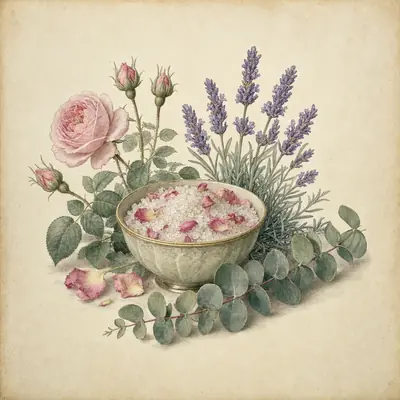
The steps
- Warm water, salt if you have it, lights off, phone in another room.
- Twenty minutes, deliberately doing nothing.
- Afterwards, write down one thing you are done carrying.
The honest part
The salt is traditional; the phone in the other room is the part that actually does the work.
You may notice the full moon before you remember the calendar: brighter rooms at night, a pale window, a slightly restless feeling that may or may not belong to the Moon at all. A bath at this point in the month gives that notice a simple form.
A cleansing bath is the most widespread full moon practice that involves nobody else and no equipment. The usual version is plain: warm water, salt if you have it, lights off, phone in another room. Stay for about twenty minutes, deliberately doing nothing. Afterwards, write down one thing you are done carrying.
Where the practice comes from
There is no single ancient practice called the full moon bath that can be traced in a clean line from one culture to the present. What does have deep roots is ritual washing. Jewish mikveh, Islamic wudu and ghusl, Hindu bathing practices, Christian baptismal imagery, Shinto misogi, and many local folk customs all treat water as a boundary marker: before prayer, after blood, after travel, before a new stage.
The full moon part is a later layering of lunar timing onto a much older human habit. In astrological and folk practice, the full moon is read as a time of visibility, culmination, and release because the lunar disk is fully lit from Earth’s view. Astronomically, the full moon is an instant, usually given in UTC, when the Moon is opposite the Sun in ecliptic longitude. Practically, people use the evening before, the night of, or the evening after.
What people actually do
The minimal version is often the most durable: run warm water, add a handful of salt if your skin tolerates it, turn off bright lights, and leave the phone outside the room. The salt is traditional; the phone in the other room is the part that actually does the work. Not because the phone is “bad,” but because interruption keeps the mind from settling into one continuous experience.
Common variations are less about secret ingredients and more about choosing a container for attention. Some people bathe by moonlight with the blinds open. Some take a shower because they do not have a tub. Some make it a foot soak, especially in shared housing or when time is short.
- Salt bath: the standard folk version, usually Epsom salt or sea salt, kept mild rather than heavily scented.
- Shower rinse: useful when a bath is unavailable; the practice is in the pause, not the plumbing.
- Herbal cloth or sachet: lavender, rosemary, or chamomile may be used for scent, but should not be loose in pipes.
- Moon water nearby: a modern addition; usually symbolic, not necessary.
- Journaling after: one sentence is enough, especially the line naming what you are done carrying.
What to skip, and why
Skip anything that makes the bath less safe or more complicated than it needs to be. Essential oils should not be dropped straight into bathwater; they can irritate skin and mucous membranes unless properly diluted. Crystals do not need to go in the tub, and some minerals dissolve, rust, shed particles, or react poorly with water. Candles are optional, but an unattended flame near towels is not a spiritual improvement.
Also skip the language of physical detox unless you mean ordinary washing. The liver, kidneys, lungs, skin, and digestive system handle bodily waste; a salt bath does not pull toxins out in a medically meaningful way. If you have eczema, broken skin, dizziness, low blood pressure, pregnancy concerns, or a medical condition affected by heat, keep the water moderate or choose a seated shower instead.
- Do not add glitter, loose herbs, or powders that will irritate skin or clog drains.
- Do not make the water very hot to prove seriousness; overheating shortens the quiet part.
- Do not mix the bath with alcohol or sedatives.
- Do not borrow closed religious forms you do not understand; use plain washing rather than costume.
- Do not turn the room into a product display. Too many objects can become another task list.
Mistakes that make it pointless
The main mistake is keeping the habit of interruption while pretending to rest. If the phone is on the edge of the tub, the bath becomes a wetter version of scrolling. If the aim is to check messages, photograph the setup, adjust the playlist, and decide whether the moonlight looks right, there is little room left for the practice itself.
Another mistake is treating the full moon as a deadline that must be obeyed exactly. The astronomical full moon has a precise UTC time, but the visible Moon looks full for more than one night to most observers. If the exact night is inconvenient, using the nearest quiet evening is more consistent with the practice than forcing it while rushed, resentful, or half-asleep.
- Doing too much: bath, scrub, mask, tea, altar, affirmations, photos, and a long journal entry can become performance.
- Waiting for perfect weather: clouds do not cancel the phase; the Moon is still there physically.
- Choosing harsh ingredients: irritation teaches the body to avoid the ritual next time.
- Writing a vague release: “negative energy” is less useful than “checking work email after dinner.”
What the full moon adds
In traditional moon practice, the full phase is read as a moment when things are easier to see. That is an image, not a measurement of personal fate. The Moon is fully illuminated because of its position relative to Earth and Sun; it is not sending instructions. Still, humans use visible cycles well. A bright, recurring sky marker can help a habit happen without needing a separate app or plan.
This is why the full moon works well for review practices. People commonly use it to name what has become obvious: an obligation that no longer fits, a pattern that keeps repeating, a conversation they are avoiding. The bath does not remove those things. It gives a quiet, bounded setting in which noticing them is harder to postpone.
What is doing the work psychologically
The useful mechanism is ordinary and strong: reduced stimulation, sensory warmth, a time limit, and a deliberate transition. Warm water tends to lower physical tension for many people. Dim light reduces input. Silence, or at least the absence of a phone, removes the most common source of interruption. Twenty minutes is long enough for the mind to stop grabbing at the next task, but short enough not to become another project.
Writing one thing down afterwards matters because it turns a vague burden into a sentence. That does not solve it automatically, and it should not be sold as a guarantee. But naming a specific load can change the next small decision: what to decline, what to finish, what to stop rehearsing. In that sense, the bath is less a cleansing force than a well-designed pause.
If this is a question rather than a habit — whether to end something, whether to wait — the useful version is usually a conversation, not a candle. Talk to a reader →
Affiliate link — we may earn a commission at no cost to you.Questions
Which salt should I use?
Any. Sea salt and Epsom are the usual choices, and the difference between them is texture, not effect.