How to Make Moon Water
Water left out under a full moon. That is the whole method, and everything else is preference.
Next full moon: Monday, October 26, 2026, 04:11 UTC
The steps
- Fill a clean glass jar with water. Filtered if you plan to drink it.
- Leave it where moonlight reaches it — a windowsill counts — overnight.
- Bring it in before the sun is high, and label it with the date and phase.
The honest part
One honest note: nothing measurable changes in the water. What changes is that you now have a labelled object tied to an intention, and objects like that are why rituals work at all.
You may notice that a full moon makes ordinary objects look chosen: a glass on the sill, a bowl on the table, a path of light across the floor. Moon water begins with that observation. Water left out under a full moon is the whole method, and everything else is preference.
The practice belongs less to ancient astronomy than to the long habit of timing household acts by the Moon. Older traditions used moon phases for planting, bathing, prayer, divination, and gathering dew or spring water; the modern phrase “moon water” is most at home in contemporary witchcraft and popular astrology. That does not make it false as a practice. It means we should describe it as a ritual object, not as altered chemistry.
In lunar practice, the full moon is read as a time of visibility, culmination, and review. Astronomically, it is the moment when the Moon is opposite the Sun in our sky, with its near side fully illuminated from Earth. The Moon does not add a measurable ingredient to the jar. The act gives the water a time, a place, and a use.
The plain method is enough
Fill a clean glass jar with water. Use filtered water if you plan to drink it, and use water you would normally consider safe for that purpose. Leave it where moonlight reaches it overnight; a windowsill counts, and so does a covered porch or balcony. Bring it in before the sun is high, then label it with the date and phase.
If you follow exact lunar timing, the full moon has a peak moment, usually listed in UTC on astronomy calendars. You do not need the jar outside at that exact minute for the practice to be coherent. Most people work with the night of the full moon, or the nearest clear evening if weather or sleep makes the exact night impractical. The label matters more than perfection, because it is what keeps the object from becoming just another forgotten jar of water.
Where the custom comes from
Moon water is often presented as if it were a single ancient formula, but that is too neat. The older pieces are real: lunar calendars, holy wells, rainwater gathering, dew collection, and the idea that certain times are better suited to certain acts. The specific household custom of putting a jar under moonlight and calling the result moon water is much more visible in modern pagan, witchcraft, and astrology communities. It is a living practice assembled from older timing traditions and newer domestic ritual.
That history is useful because it keeps the practice flexible. There is no central authority deciding whether a window is valid, whether the lid must be metal, or whether cloudy weather cancels the jar. Different lineages and books may prefer different rules, but most ordinary practice is simpler. A clean vessel, drinkable water if drinking is intended, moonlit timing, and a clear use are the stable parts.
Common variations people actually use
People vary moon water according to what they want the ritual to support as a habit. Some use the full moon for review, gratitude, or closure; others make water at the new moon for beginnings, or during waxing and waning phases for building and letting go. In astrology-based practice, some label the jar with the moon sign as well as the phase. These meanings are traditional readings, not physical properties of the water.
- Tap water is fine if it is safe where you live; use filtered water if taste or drinking safety matters to you.
- A windowsill is acceptable, especially in apartments or bad weather; direct outdoor moonlight is not required.
- Some people write a word or short intention on the label, but a plain date and “full moon” is enough.
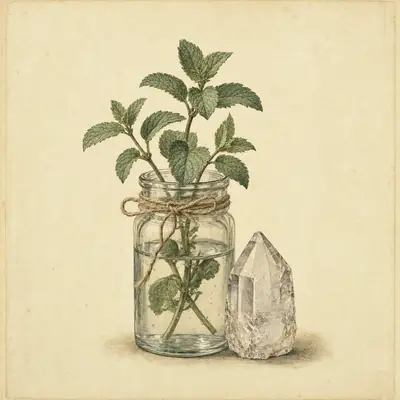
- Herbs, flowers, or crystals are common additions for non-drinking use, but they change the safety question.
- A covered jar is better than an open bowl if it will sit outside, because insects, dust, and animals are real.
Variations work best when they serve the later use. A jar made for a bath can tolerate additions that would be a poor choice in drinking water. A jar made for a desk or altar does not need to be edible at all. The practical question is not “Is this more mystical?” but “Will I safely use this object in the way I intend?”
What to skip, and why
Skip unsafe ingredients in any water you might drink. Essential oils are not automatically safe internally, even when they smell gentle. Many crystals can leach unwanted substances, shed particles, or simply make the water dirty; malachite, pyrite, selenite, and copper-bearing stones are common examples to keep out of drinking jars. If you want stones involved, place them beside the jar instead of inside it.
Skip dramatic rules that make the practice impossible to repeat. If a source says the jar must be outside, uncovered, under perfect direct moonlight, at the exact astronomical minute, it is describing one style rather than a universal rule. Weather, buildings, and sleep are part of real life. A ritual that survives ordinary conditions is usually more useful than one that fails whenever the sky is cloudy.
Some traditions avoid eclipses for moon water, reading them as unstable or unsuitable for ordinary charging work. Other practitioners use eclipses deliberately for shadow work or endings. If you do not have a reason, skip the eclipse and choose a regular full moon. Restraint is not less traditional than intensity.
Mistakes that make it pointless
The most common mistake is making moon water and never assigning it a use. A labelled jar can support a habit only if it enters one: watering a plant, beginning a journaling session, rinsing a tool, adding a little to a bath, or simply sitting where it reminds you what you chose to review. Without that link, the ritual ends at storage. Then the jar becomes clutter with a moon date on it.
- Do not drink water that was left open outdoors or mixed with non-food-safe objects.
- Do not keep drinking moon water for weeks; treat it like ordinary water and refrigerate it if needed.
- Do not make five jars because one would feel insufficient; excess often weakens attention rather than deepening it.
- Do not worry if clouds pass over the Moon; the practice is timed by the night, not by a laboratory dose of light.
- Do not use a container you cannot clean well, especially if you plan to drink from it.
Another mistake is treating the label as decoration instead of record. Write the date, the phase, and any brief intention in language you will understand later. If you track the moon sign, add it, but do not let the astrology become a barrier. The plainest label can be the strongest one if it tells you exactly what the jar is for.
What is doing the work
One honest note: nothing measurable changes in the water. Ordinary moonlight is reflected sunlight, and the amount reaching a jar on a windowsill is small. The water does not become chemically different in a way that explains ritual effects. What changes is that you now have a labelled object tied to an intention, and objects like that are why rituals work at all.
Psychologically, moon water works as a cue, a boundary, and a memory aid. Making it slows an intention down enough for you to name it, handle it, and return to it later. The full moon gives the act a visible calendar marker, which helps repetition without needing a complicated system. None of this guarantees an outcome, but it can make a chosen habit easier to notice and repeat.
A simple way to use it
Choose one use before you put the jar out. For example, you might use a spoonful in a bath after a difficult month, water a houseplant while writing one sentence of review, or place the jar on your desk for one evening of planning. Small uses keep the object connected to action. Large promises usually do the opposite.
When the jar is finished, empty it plainly and clean the container. You do not need a disposal ceremony unless your own tradition has one. If you keep notes, record what you used it for rather than whether it “worked.” That keeps the practice honest: a full-moon ritual made of water, timing, attention, and follow-through.
If this is a question rather than a habit — whether to end something, whether to wait — the useful version is usually a conversation, not a candle. Talk to a reader →
Affiliate link — we may earn a commission at no cost to you.Questions
Is it safe to drink moon water?
If the water was drinkable before and the jar was clean, yes. Do not use untreated water, and do not leave it out for days.