Buck Moon
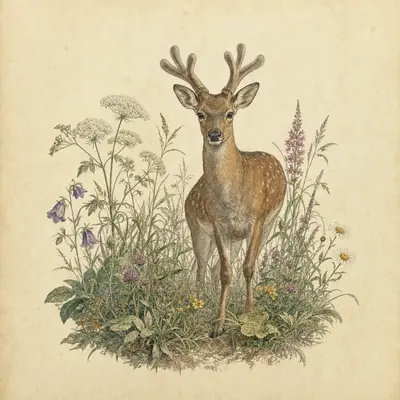
Unlike June’s Strawberry Moon, which points to a berry harvest, July’s name follows an animal’s seasonal cycle. The Buck Moon refers to the growing antlers of male deer, while alternatives such as Salmon Moon and Hay Moon reflect other regional signs of summer.
, 2027
· 15:45 UTC · Moon in Capricorn
Where the name comes from
The Old Farmer’s Almanac explains Buck Moon as a name for the period when male deer’s antlers are in full growth. Bucks shed and regrow their antlers each year, and the Farmers’ Almanac describes the developing antlers as covered in soft velvet. The publications differ slightly on timing: Royal Museums Greenwich and the Farmers’ Almanac describe growth beginning in July, while the Old Farmer’s Almanac emphasizes growth already underway. The shared reference is summer antler development, rather than an event caused by the full moon. This seasonal setting belongs to the Northern Hemisphere; the name is not a description of conditions everywhere.
Both the Old Farmer’s Almanac and the Farmers’ Almanac include Buck Moon in their lists of traditional full moon names. The Old Farmer’s Almanac says its wider naming collection draws on Native American, colonial American, and European traditions, and notes that names traditionally applied to an entire lunar month rather than only its full moon. Its July alternatives include Salmon Moon as a Tlingit term, Raspberry Moon as an Algonquin, Ojibwe name, and Thunder Moon as a Western Abenaki name. These publication attributions are more useful than treating the familiar English-language list as one shared Indigenous calendar. Each alternative points toward a particular regional observation rather than a universal summer schedule.
Other names for the July full moon
- Salmon Moon — Tlingit
- Raspberry Moon — Algonquin, Ojibwe
- Thunder Moon — Western Abenaki
- Hay Moon — Anglo-Saxons
What the season is doing
Across parts of the northern United States, the names direct attention to summer growth in woods, fields, and waterways. Deer antlers are developing, berries are ripening, and hay cutting gives a farming counterpart to those woodland signs. The Old Farmer’s Almanac also lists Berry Moon as an Anishinaabe term and Moon When the Chokecherries are Ripe as a Dakota name, adding more specific references to ripening fruit. Its Tlingit attribution for Salmon Moon refers to returning fish and their harvest, a regional signal rather than something expected in every northern waterway. Taken together, these names describe overlapping seasonal activities, not a checklist that every woodland, farm, and river follows at once.
What the name does not mean
A common misunderstanding is that a named full moon must have a distinctive appearance. Buck Moon describes what deer are doing, not a color, shape, or marking on the lunar surface. The name itself does not make the moon larger or brighter, and the alternative Thunder Moon is a reference to seasonal storms, not a different kind of moon. Royal Museums Greenwich explains both names through events on Earth: antler regrowth and summer thunderstorms. The label supplies seasonal context rather than a separate astronomical category.
Buck Moon dates, 2025 to 2030
Between 2025 and 2030 the Buck Moon falls as early as July 6 (2028) and as late as July 29 (2026), in Capricorn or Aquarius: a full moon sits opposite the Sun, which at this time of year is in Cancer or Leo.
The Buck Moon is the same disc for everyone. Which part of your own chart it falls across depends on your birth date, and that is what a personal reading looks at. See a reading built from your birth moon →
Affiliate link — we may earn a commission at no cost to you.Questions
When is the Buck Moon in 2027?
On Sunday, July 18, 2027, at 11:45 AM EDT (15:45 UTC), with the Moon in Capricorn. Central, Mountain and Pacific clocks read one, two and three hours earlier.
Why is the Buck Moon also called the Thunder Moon?
Royal Museums Greenwich connects Thunder Moon with summer storms. Attribution varies: the Old Farmer’s Almanac lists it as a Western Abenaki name, while the Farmers’ Almanac describes it as colonial American. The weather reference is consistent across those explanations, but the publications do not give it the same cultural origin.
Is the Buck Moon also called the Hay Moon?
Hay Moon is another name listed for July’s full moon. Timeanddate credits it to the Anglo-Saxons, while Royal Museums Greenwich explains it through the July hay harvest. Where Buck Moon draws attention to deer, this alternative records a seasonal task in the fields; neither label describes a change in the moon itself.
Does the Buck Moon mark the start of antler growth?
The Farmers’ Almanac and Royal Museums Greenwich present July as the beginning of regrowth, but the Old Farmer’s Almanac describes antlers in full-growth mode. Those explanations differ on the starting point. Summer antler development is the common seasonal reference, without implying that growth begins at the full moon.
The months either side
Sources for the name and its history: almanac.com · timeanddate.com · farmersalmanac.com · en.wikipedia.org · rmg.co.uk · science.howstuffworks.com · time.com · countryliving.com. Dates, times and signs: our own calculation, checked against the US Naval Observatory.