Sturgeon Moon
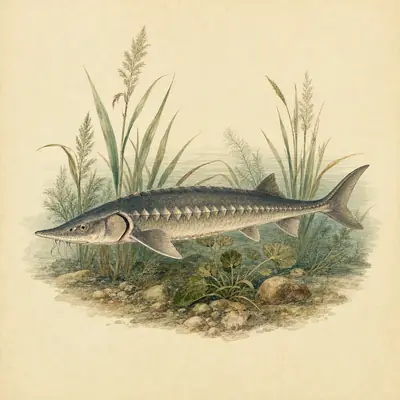
August's full moon is called the Sturgeon Moon because lake sturgeon were traditionally more readily caught in regional waterways in late summer. The name points to a fishing season, not a change in the Moon. Almanacs keep this seasonal label in use.
, 2027
· 07:29 UTC · Moon in Aquarius
Where the name comes from
Lake sturgeon in the Great Lakes, Lake Champlain, and nearby waterways provide the seasonal link behind August's familiar moon name. These large freshwater fish were an important food source for Indigenous communities in the region. The Old Farmer's Almanac connects the name with fish that were once abundant and readily caught during this part of summer. The Farmers' Almanac likewise emphasizes seasonal catches, while timeanddate stresses the large numbers of fish in the lakes. These accounts differ in emphasis rather than offering wholly separate explanations: the common thread is the fish's availability and importance as food.
The familiar August label belongs to the naming tradition now circulated by almanacs, not to a single calendar shared by all Indigenous peoples. The Old Farmer's Almanac explains that its moon names draw on Native American, Colonial American, and European sources, and that such names traditionally covered an entire lunar month rather than only the full moon. Among its alternatives, it lists Flying Up Moon as a Cree term, Ricing Moon as Anishinaabe, and Black Cherries Moon as Assiniboine. In a separate naming tradition, timeanddate gives Grain Moon as an Anglo-Saxon name.
Other names for the August full moon
- Flying Up Moon — Cree
- Ricing Moon — Anishinaabe
- Black Cherries Moon — Assiniboine
- Grain Moon — Anglo-Saxons
What the season is doing
These names describe a Northern Hemisphere season, with the fishing association rooted particularly in waterways of the northern United States. Alongside the lake harvest, the alternatives point toward ripening crops, gathering rice, and chokecherries becoming ready to pick. The Old Farmer's Almanac explains Flying Up Moon as a reference to young birds being ready to fly, adding an animal milestone to the food-gathering names. Taken together, the labels record several kinds of seasonal readiness, rather than suggesting that every crop ripens or every bird leaves the nest at the same moment across the region.
What the name does not mean
The name does not mean that August's full moon has a distinctive color. The Farmers' Almanac includes Red Moon among its alternative names, but that is another traditional label, not a promise of a red lunar disk. A reddish appearance can be associated with haze or with seeing the Moon near the horizon; it is a viewing condition, not something caused by the sturgeon name. The fishing label tells you what people associated with the season on Earth, not what color to expect in the sky.
Sturgeon Moon dates, 2025 to 2030
Between 2025 and 2030 the Sturgeon Moon falls as early as August 5 (2028) and as late as August 28 (2026), in Aquarius or Pisces: a full moon sits opposite the Sun, which at this time of year is in Leo or Virgo.
The Sturgeon Moon is the same disc for everyone. Which part of your own chart it falls across depends on your birth date, and that is what a personal reading looks at. See a reading built from your birth moon →
Affiliate link — we may earn a commission at no cost to you.Questions
When is the Sturgeon Moon in 2027?
On Tuesday, August 17, 2027, at 3:29 AM EDT (07:29 UTC), with the Moon in Aquarius. Central, Mountain and Pacific clocks read one, two and three hours earlier.
Is the Sturgeon Moon always a supermoon?
No. Sturgeon Moon is a seasonal name, while supermoon describes a full moon occurring when the Moon is relatively close to Earth in its orbit. The two labels can apply together, but neither requires the other. The fish-related name alone tells you nothing about the Moon's apparent size or brightness.
Does the Sturgeon Moon refer to a whole month or just one night?
In the tradition described by the Old Farmer's Almanac, moon names applied to the lunar month as a whole. Modern almanac pages commonly attach them to the full moon itself. That distinction helps explain why the names describe extended activities such as fishing, ripening, and gathering rather than an event confined to one night.
Are sturgeon still plentiful during the Sturgeon Moon?
The historical name is not a report of present-day fish populations. The Old Farmer's Almanac says lake sturgeon were once much more abundant and are rarer today, citing intense overfishing as a cause of their decline. The name preserves an older seasonal association rather than promising a plentiful catch.
The months either side
Sources for the name and its history: almanac.com · timeanddate.com · farmersalmanac.com · en.wikipedia.org · science.howstuffworks.com · mentalfloss.com · star-name-registry.com · abcnews.com. Dates, times and signs: our own calculation, checked against the US Naval Observatory.